Throughout my university studies, the notions of Canadian identity and nation-branding have really interested me. For this reason, Eva Mackey’s (2002) concept of multiculturalism as a “‘great national bandage’ that helps to heal the ‘national fabric’,” really struck me as an interesting concept (p.67). To hear Mackey describe its symbolic purpose so bluntly is refreshing and insightful.
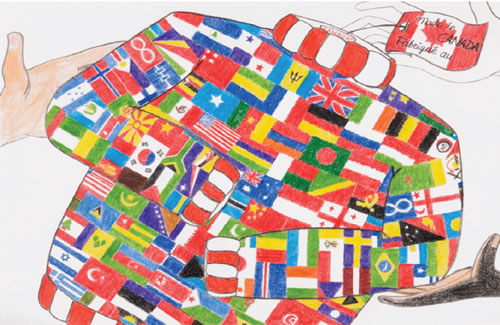
Prime Minister Lester B. Pearson noted this crisis and set to ensuring the future of a cohesive new Canada. To accomplish this, the Prime Minister emphasized unique and “inclusive symbols of Canada”, such as a brand new flag (Mackey, 2002, p.56). Overarching Canadian symbols do not represent any one identifiable culture, but rather manage to encompass all cultural backgrounds under the banner of “Canada”. It is through this emphasis of Canadian over Quebecois , Italian-Canadian, etc., that allowed these diverse cultures to coexist and established multiculturalism as a symbol of Canadian unity.
Aside from smoothing the growing tensions between cultural groups within Canada, the multicultural approach gave Canadians a way of defining themselves as a nation. Before the identification of multiculturalism, Canada as a nation was often defined in the negative; not quite American, and not quite British. Now, with its own approach to national unity, Canada could define itself as something unique. Multiculturalism also provided Canadians with a source of pride, being a “made in Canada” solution to intolerance and discrimination between cultures.
Of course, Canadians did not automatically accept the concept of “multiculturalism is Canadian.” Public and political discourse played an important role in ensuring that Canadians adopted multiculturalism as a core Canadian value. Fortunately, as Mackey (2002) explains, centennial celebrations and Expo 67 provided excellent opportunities for the government to show Canadians how wonderful a diverse society could be. Today, festivals and events across the country continue to celebrate the many cultures that are present in Canada.
Since the initial symbolic gesture of fostering the coexistence of cultures, multiculturalism has become entrenched in political, legal and social policies in Canada. In 1982, with the Canadian Charter of Rights and Freedoms, the respect and acceptance of all cultures became legally protected within the constitution. From this highest legal position, the values of multiculturalism have trickled-down throughout Canadian organizations. For example, the Canadian Broadcast Standard Council enforces the Canadian Association of Broadcasters’ Equitable Portrayal Code which ensures that all people – regardless of culture, race, religion or gender – are appropriately and justly represented in the media.
Today, accepting multiculturalism is part of the socialization process of new and young Canadians. In immigration documents such as the Discover Canada booklet, individuals applying for citizenship are made aware that multiculturalism is a “fundamental characteristic” of Canada (Canada, 2010, p.8). For young Canadians, tolerance and acceptance is often taught by Canadian parents. Multiculturalism is also its own unit in school curricula. I still remember learning about the “tossed salad” and “mosaic” metaphors describing Canada’s stance on plurality. Finally, multicultural imagery is all around us. One need look no further than the diverse smiling faces of posters or brochures for Canadian products and services.
Unfortunately, despite all of this discourse and positive imagery, multiculturalism’s greatest success remains as a symbol of national identity. As we’ve seen in our readings and in the news, policies on immigration and statistics about new Canadians show that there is still a long way to go to achieve true equality between cultural groups in Canada. However, I wonder what the situation for cultural minorities would have been if Canadians did not even believe or discuss the idea of multiculturalism.
References
Canada. (2010). Discover Canada: The Rights and Responsibilities. Retrieved September 28, 2010, from http://www.cic.gc.ca/english/pdf/pub/discover.pdf
Mackey, Eva. (2002). Managing the House of Difference: Official Multiculturalism. In The House of Difference: Cultural Politics and National Identity in Canada (pp.50-70). Toronto: University of Toronto Press.
Photo Credit: http://www.cic.gc.ca/english/resources/publications/multi-report2009/part1-1a.asp

very nice article.. I was wondering how you do the read more tad tho. Like how it only shows the first 10 lines and then the rest is hidden? hopefully you can help me out!! great blog
ReplyDelete